
A10 Algorithm: How Amazon Search Is Moving Beyond Keywords to Customer Intent
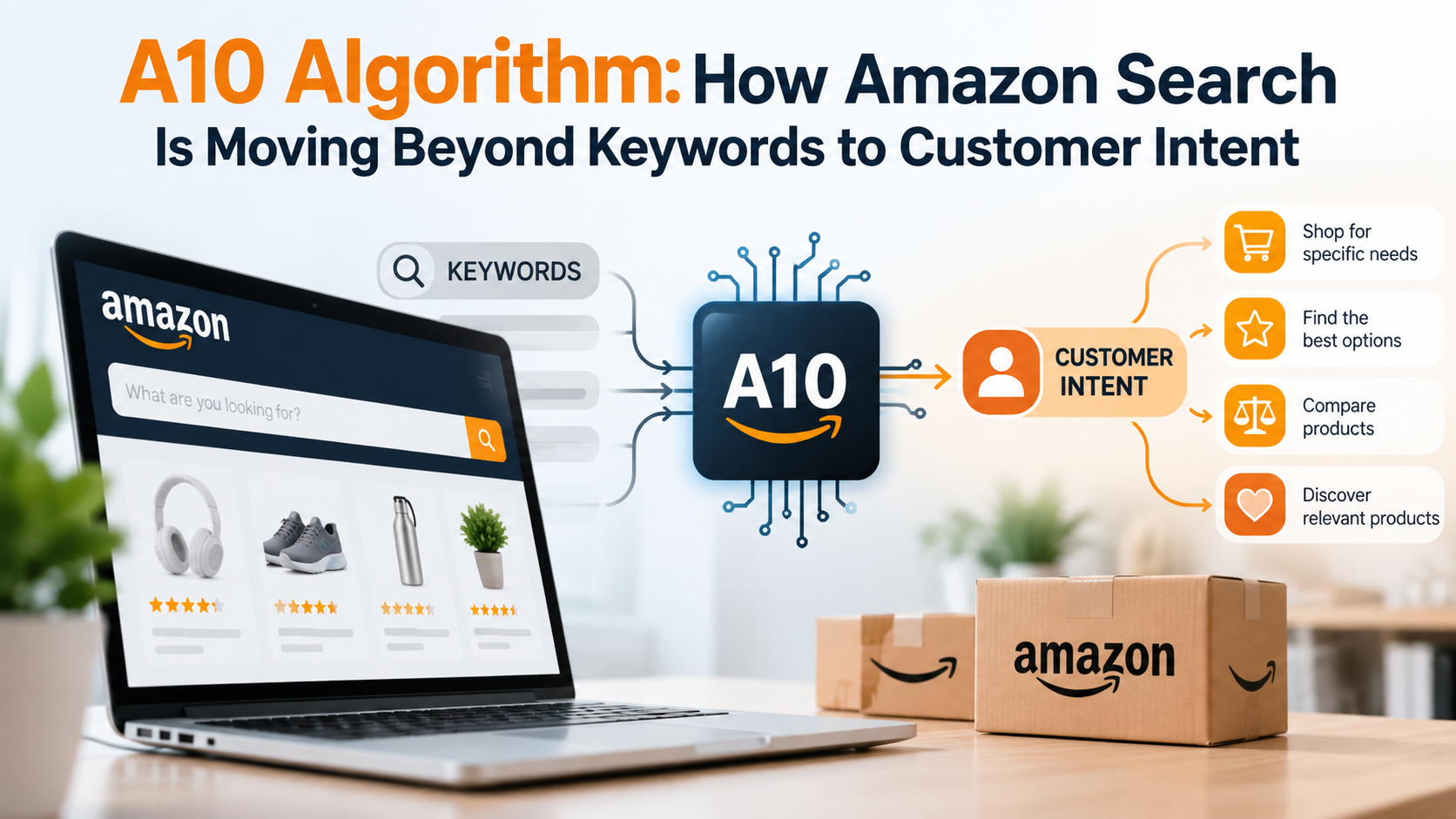
A10 Algorithm: How Amazon Search Is Moving Beyond Keywords to Customer Intent
For years, Amazon sellers competed by optimizing listings around exact keywords, assuming that greater keyword coverage would translate into better visibility. However, as Amazon search becomes more intelligent, ranking increasingly depends on how well a product matches the customer’s intent behind a query.
This shift is becoming more noticeable as shoppers adopt AI-powered shopping experiences, voice assistants, and conversational search. Instead of typing short phrases, customers are now using conversational queries to find relevant products by describing their needs, preferences, and specific requirements.
For sellers, this changes the role of keyword optimization. Keywords still help Amazon understand product relevance, but they no longer determine search performance. In the A10 algorithm, search performance increasingly depends on how effectively a listing helps customers make confident buying decisions, not how many keywords it contains. This means listings must now provide meaningful context, align with shopper intent, reduce purchase hesitation, and support Amazon’s conversion signals to deliver value.
The Shift: Why Keyword Stuffing No Longer Works on Amazon
1. Amazon Search Landscape Is Moving from Keyword Matching to Intent Understanding
Keyword optimization is still a fundamental part of Amazon SEO. Amazon needs product information to understand what a product is and identify relevant search opportunities. However, modern search systems are becoming better at interpreting context, relationships, and customer intent.
Earlier optimization strategies focused heavily on exact-match phrases. Sellers often repeated the same keywords across multiple sections of a listing because search engines had limited ability to understand related concepts.
For example, a seller targeting the term “wireless gaming headset” might repeatedly include that phrase throughout the product page. However, today Amazon can understand related attributes such as low-latency audio, microphone quality, gaming compatibility, surround sound, and console support.
The question is no longer only: “Does this listing contain the keyword?”
It is increasingly: “Does this product appear to solve the customer’s specific requirement?”
This shift makes semantic relevance more important than keyword frequency. A listing that clearly explains product benefits, use cases, specifications, and differentiators can provide stronger relevance signals than a keyword-heavy listing that lacks meaningful information.
2. Conversational Search Is Changing How Customers Discover Products
The growth of conversational commerce is one of the biggest reasons keyword stuffing has become less effective. Traditional search required customers to translate their needs into short phrases. They had to predict which words Amazon would recognize. Voice and AI shopping assistants remove much of that limitation by allowing customers to communicate naturally.
Instead of typing: “office chair lumbar support”
A shopper can ask: “Find an ergonomic office chair for someone working eight hours a day with adjustable back support under $300.”
The second query contains multiple intent signals. The customer isn’t just looking for an office chair. They have defined their expected usage duration, comfort requirement, feature preference, and budget.
Amazon’s AI-powered shopping experiences, including Alexa for Shopping, are designed to handle these more detailed interactions. Customers can ask product-related questions, compare options, explore recommendations, and refine their requirements through follow-up conversations.
This changes how sellers should approach Amazon listing optimization. The goal is no longer to rank for every possible keyword variation. The goal is to provide enough contextual information for Amazon to understand when a product is the right answer to a customer’s need.
Product detail pages should communicate the complete buying context:
- Who is the product designed for?
- What problem does it solve?
- Where is it used?
- Which features influence the purchase decision?
- How does it compare with alternatives?
These signals help Amazon connect products with increasingly complex search journeys.
3. Search Visibility Depends on Conversion Signals on Amazon
Getting a product displayed in search results is only the first step. Amazon’s A10 algorithm also evaluates what happens after customers interact with a listing.
A product that receives impressions but generates few clicks may indicate weak search-result appeal. A product that attracts clicks but fails to convert may indicate it doesn’t meet the shopper’s expectations. This is why conversion-related signals have become central to Amazon SEO.
Several factors influence whether shoppers move from discovery to purchase:
- Product relevance to the search intent
- Content quality
- Main image quality
- Product pricing
- Reviews and ratings
- Competitive positioning
A keyword-optimized listing cannot compensate for a poor customer experience. If shoppers repeatedly leave without purchasing, it signals to the A10 algorithm that the product may not be the strongest match for that search. Amazon SEO is therefore not about attracting the most visitors. It is about attracting qualified shoppers who are likely to purchase.
4. Customer Experience Signals Influence Long-Term Rankings
Amazon prioritizes customer experience and trust. As a result, post-purchase performance also contributes to long-term product visibility. A product may initially gain attention through advertising, promotions, or strong listing optimization. However, customer feedback determines whether that visibility is sustainable.
Reviews, ratings, return behavior, product quality issues, and expectation gaps all signal to Amazon’s A10 algorithm whether a product delivers what the listing promised. For example, if a product description highlights a feature that customers later find inaccurate, negative reviews may increase and affect future purchase decisions.
This reinforces a critical principle for Amazon sellers: Search relevance does not end when a customer clicks “Buy Now.”
The strongest-performing products align search intent, listing information, purchase expectations, and the actual customer experience.
How to Optimize Product Listings and Content for the A10 Algorithm
1. Build Product Listings Around Shopper Intent
The first step in Amazon listing optimization is to move beyond keyword collection and understand customer intent.
Instead of asking: “Which keywords should be added to this listing?”
Sellers should ask: “What decision is the customer trying to make?”
This requires analyzing customer reviews, competitor listings, advertising search-term reports, product questions, and customer feedback. Intent-based optimization helps sellers create product pages that match how customers actually evaluate products.
2. Create Context-Rich Product Content
Amazon listings should help both customers and AI systems understand the product. Product titles should clearly communicate the product category and major differentiators without unnecessary repetition.
Bullet points should explain benefits, not simply repeat keywords. Product attributes should provide accurate specifications that help Amazon categorize and recommend the product correctly.
Backend search terms still have value, but they should support discoverability rather than compensate for weak visible content.
3. Improve Conversion Signals After Keyword Discovery
Keyword optimization can help a product appear for relevant searches, but ranking performance depends on what happens after customers discover the listing.
The A10 algorithm evaluates customer response signals that indicate whether a product successfully satisfies search intent. A listing that attracts clicks but fails to generate purchases may indicate that the product content, pricing, or offer does not align with customer expectations.
Therefore, sellers should optimize the listing for a complete product experience after keyword discovery. High-quality images, clear benefit-focused copy, competitive pricing, strong reviews, and accurate product information help convert relevant traffic into purchases.
The objective is not to maximize keyword visibility alone. It is to ensure shoppers who discover the product have enough evidence to make a confident buying decision.
4. Use PPC Search Data to Refine Keyword Strategy
Amazon PPC campaigns provide valuable insights into how customers search and which queries lead to conversions.
Search-term reports can reveal high-performing keywords, emerging customer language, and search variations that may not have appeared during initial keyword research. Sellers can use these insights to refine listing content, improve keyword targeting, and identify additional customer intents.
For example, if a specific long-tail search term consistently generates conversions through advertising, sellers should evaluate whether the product listing clearly addresses that requirement. If the intent isn’t reflected in the content, an opportunity exists to improve relevance signals.
5. Bring Specialized Expertise Into Your Amazon SEO Strategy
Optimizing for the A10 algorithm requires specialized expertise in understanding ranking factors, interpreting performance data, and improving listings beyond keyword placement alone. Sellers need Amazon SEO specialists who can identify relevant search opportunities, optimize product content, and align listings with customer response signals that influence search performance.
Businesses can build this capability by hiring dedicated Amazon SEO professionals for their internal teams. However, for sellers who want specialized expertise without increasing internal hiring, training, and management overhead, specialized Amazon SEO services can be a practical alternative.
The right approach depends on a seller’s resources, marketplace scale, and long-term growth objectives.
Conclusion: Shift the Focus Towards Building an Intent-First Amazon SEO Strategy
The shift from keyword-based ranking to intent-driven search requires sellers to rethink their Amazon SEO approach. The next step is not abandoning keyword optimization, but integrating it with deeper customer understanding, stronger product content, and continuous performance analysis.
Sellers should start by auditing existing listings to identify where keyword targeting focuses only on search volume rather than customer intent. Product pages should then be optimized around the questions shoppers are trying to answer, the problems they are trying to solve, and the attributes that influence purchase decisions.
At the same time, sellers need to use Amazon PPC search-term data, customer feedback, reviews, and conversion performance data to continuously refine their SEO strategy. As AI-powered shopping experiences become more common, the brands that succeed will treat Amazon SEO as an ongoing process of understanding customer intent, improving relevance, and proving product value at every stage of the shopping journey.
Author Bio: Jessica Campbell is an eCommerce consultant and content strategist at Data4Amazon. She has published over 2000 articles & informative write-ups about eCommerce & Amazon marketplace solutions covering Amazon listing optimization, Amazon PPC management services, Amazon SEO & marketing, Amazon store setup, and Amazon product data entry. Her well-researched and valuable write-ups have helped thousands of businesses uncover rich insights, strengthen their business processes, and stay afloat amidst the rising competition.
FAQs
1. What is the A10 algorithm on Amazon?
The A10 algorithm is Amazon’s search ranking system that determines which products appear for customer searches. While keywords remain important for product relevance, A10 also considers customer intent, conversion signals, product content, reviews, pricing, and overall customer experience.
2. Does keyword stuffing still work for Amazon SEO?
No, keyword stuffing is no longer an effective Amazon SEO strategy. Keywords help Amazon understand product relevance, but sellers should focus on creating context-rich listings that clearly address customer needs, product benefits, features, and use cases.
3. How does customer intent affect Amazon search rankings?
Customer intent helps Amazon determine how well a product matches what a shopper is actually looking for. Listings that clearly address specific customer requirements and provide accurate, useful information can better align with intent and support stronger conversion signals.
4. How can sellers optimize Amazon listings for the A10 algorithm?
Sellers can optimize for A10 by building listings around shopper intent, creating informative product titles and benefit-focused bullet points, using accurate product attributes, improving images and pricing, maintaining strong reviews, and analyzing PPC search-term data to identify high-converting search queries.
5. Are keywords still important for Amazon SEO?
Yes. Keywords remain important because they help Amazon understand a product and identify relevant search opportunities. However, keyword optimization should be combined with customer-intent analysis, high-quality product content, strong conversion performance, and a positive customer experience.